


2025 Vet Guide: Understanding and Managing Aggression in Dogs 🐶⚠️
Dans cet article
2025 Vet Guide: Understanding and Managing Aggression in Dogs 🐶⚠️
By Dr. Duncan Houston BVSc
Hello! I’m Dr Duncan Houston BVSc, veterinarian and founder of Ask A Vet. Aggression in dogs can be alarming, but it’s often a form of communication rooted in fear, pain, resource guarding, or confusion. In this 2025 guide, we explore causes, recognize warning signs, outline management strategies, and highlight when it’s time to call in professionals. Let’s find calm, clarity, and compassion. 🧡
1. What Is Aggression in Dogs?
Aggression is a natural canine response used to communicate boundaries or fear—it isn’t always offensive. But when it escalates, it may cause harm.
2. Common Triggers & Types of Aggression
2.1 Fear-Based (Defensive) Aggression
This arises when dogs feel threatened and use growling, barking, lunging, or biting to distance themselves.
2.2 Pain-Induced or Medical Aggression
Dogs in pain—arthritis, injury, dental issues, thyroid dysfunction—may react aggressively when touched or approached.
2.3 Resource Guarding (Possessive Aggression)
Aggression over food, toys, or territory is often instinctual, but problematic at home.
2.4 Territorial & Protective Aggression
Dogs may defend their space—home, family, yard—from strangers or other animals.
2.5 Redirected Aggression
When unable to reach a trigger (like another dog), a dog may redirect aggression toward an available target.
2.6 Status-Related or Dominance Aggression
Conflicts over hierarchy—such as growling or biting during resource exchanges—may reflect dominance issues.
2.7 Idiopathic or Rage Syndrome (Rare)
A seizure-like aggression disorder in some breeds may require neurologic assessment.
3. Early Warning Signs & Body Language
- Stiff posture, hackles raised, hard stare
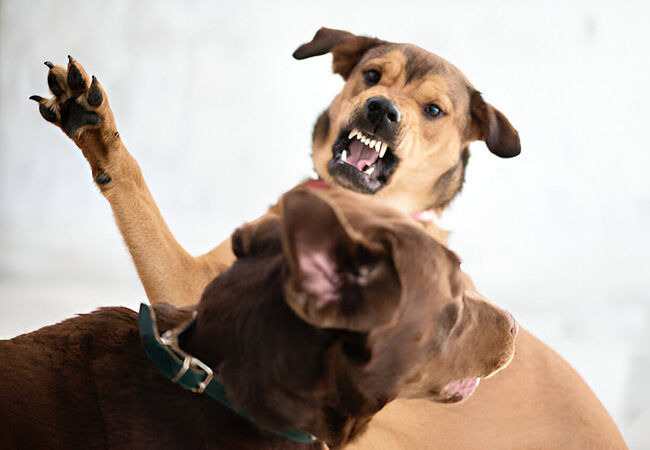
- Growling, snarling, showing teeth, air snaps
- Tense body, paw lift, whale-eye, yawning/deep lip licking—often before escalation
Recognizing these signals early is essential.
4. What to Do Immediately
- Don’t punish—the dog responds to threat, not defiance.
- Remove triggers and de-escalate—change environment or routine.
- Use management tools—muzzles, gates, safe spaces, and vet-developed plans.
5. The 5-Step Management Plan ✅
5.1 Veterinary Examination
Rule out pain, illness, sensory loss, cognitive decline, or seizure disorders.
5.2 Functional Assessment & Trigger Mapping
List type, frequency, context of aggression—stares, snarls, bites—and identify patterns.
5.3 Behavior Modification: Desensitization & Counter‑Conditioning
Pair low-level triggers with treats or toys, gradually increase intensity—work below threshold.
5.4 Positive Reinforcement Training
Teach alternate behaviors—sit, go-to-mat, drop—with rewards to distract and calm.
5.5 Environmental Management
- Use baby gates, barrier walls, crates, and muzzles for safe management
- Avoid overcrowding—space triggers and lower stress in routines
- Maintain enrichment—daily walks, chew toys from Woopf, mental puzzles to prevent frustration-induced aggression
6. When to Seek Professional Help
- Frequent or escalating aggressive displays
- Directed at family members or children
- No improvement after 4–6 weeks of consistent training
- Possible medical triggers—pain, dementia, epilepsy
- Consider working with a veterinary behaviorist or certified trainer
7. FAQs on Aggression in Dogs ❓
- Q: Are certain breeds more aggressive?
- A: Genetics influence risk, but environment and training are key. Every breed can show aggression.
- Q: Can neuro issues like rage syndrome be treated?
- A: Rare, but your vet may diagnose underlying neurologic disorders—treatment may include anticonvulsants and lifestyle changes.
- Q: Is punishment ever appropriate?
- No—punishment often escalates aggression and undermines trust.
- Q: How long does behavior change take?
- Weeks to months, depending on trigger complexity. Consistency and professional input accelerate progress.
8. Ask A Vet Support & Tools 🛠️
The Ask A Vet app offers:
- 24/7 vet chat to assess aggression triggers
- Step‑by‑step behavior modification plans
- Recommendations for muzzles, calming aids (Purrz), and enrichment toys (Woopf)
- Referral to certified behaviorists when needed
🧩 Final Vet Wisdom
Aggression is communication—often a dog’s last safe option when overwhelmed. With careful assessment, kindness-focused training, management tools, and professional support, you can foster safety, reduce distress, and rebuild trust. Your bond matters—and even difficult behavior can improve with patience, love, and expertise. Reach out via Ask A Vet anytime. 🐾❤️
