


4 Hand Signals for Dogs You Can Teach Your Pup 2025: Vet Reviewed Training Tips 🐾
Dans cet article
4 Hand Signals for Dogs You Can Teach Your Pup 2025: Vet Reviewed Training Tips 🐾
By Dr. Duncan Houston BVSc
Teaching hand signals enhances your communication with your pup—especially in noisy environments, for future hearing loss, or when your hands are full. This vet‑approved guide introduces four foundational hand cues—Sit, Down, Come, Stay—with easy step-by-step instructions, troubleshooting tips, and ways to reinforce learning using trusted tools like Ask A Vet,
1. 🧠 The Benefits of Hand Signal Training
- Useful in loud settings or when voice commands aren’t heard.
- Prepares dogs for future hearing loss.
- Enhances clarity and builds a visual‑verbal bond.
Veteran trainers and service dog providers often pair verbal and silent cues to ensure reliable responses.
2. 👆 Teaching the Sit Signal
Hand signal: Raise your hand, palm up, from your side to shoulder height.
- Start with verbal and visual cues together.
- When your pup sits, click and reward immediately.
- Repeat until sits reliably on signal alone.
- Introduce mild distractions gradually and reinforce.
Tip: Keep training sessions short (5–10 min) and consistent.
3. 👇 Teaching the Down Signal
Hand signal: With palm facing down, sweep your hand from head to side at the level of the dog's nose.
- Pair verbal “Down” with the hand sweep.
- Reward as soon as the pup touches the floor.
- Gradually remove the verbal cue.
- Practice with focus-building exercises later.
Tip: If the pup rushes into down too fast, reinforce gradual compliance.
4. 👋 Teaching the Come Signal
Hand signal: Extend arm out sideways (palm up), then sweep hand toward opposite shoulder.
- Start close to pup with verbal “Come.”
- Reward enthusiastically when they arrive.
- Practice at increasing distances.
- Ensure the comeback is fun—avoid surprise or punishment.
Tip: Only call your pup when it’s safe—never punish after recall.
5. ✋ Teaching the Stay Signal
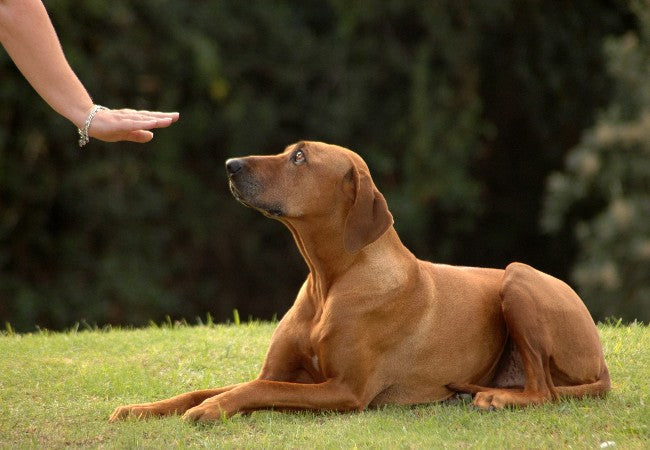
Hand signal: Raise palm flat toward pup like a stop sign.
- Cue your pup to sit/down, then present a hand signal.
- Take one step back—if they stay, reward; if not, reset.
- Increase duration and distance gradually.
- Add distractions only after mastery at closer range.
Tip: Use Ask A Vet to develop a progression tailored to your dog’s age and temperament.
6. ⚠️ Troubleshooting Common Challenges
- Too fast for distraction: shorten sessions, reduce distractions.
- Verbal overshadowing: introduce the hand cue before verbal.
- Hand inconsistency: use the same gesture and timing.
7. 🛠 Tools to Enhance Training
- Ask A Vet app: personalized selfie‑video feedback and behavioral plans.
8. 🗓 Progression Plan & Timeline
| Week | Focus | Goals |
|---|---|---|
| 1 | Sit + come signals | 5 reps each on cue in a distraction‑free zone |
| 2 | Down + stay signals | Short durations for each |
| 3 | Increase distance | 2 m for sit/down; 5 m for come |
| 4 | Add mild distractions | 10 s hold in busy room or yard |
| 5+ | Real life practice | Response at cafes, walks, varied settings |
9. 🎓 Why It Matters Long-Term
- Prepares dogs for lifelong communication—even into senior years.
- Supports daily safety, obedience, and bonding.
- Useful in emergencies or when voice isn't an option (e.g. vet visit, crowds).
10. 📌 Final Takeaways
- Hand signals strengthen communication—key for noisy or distance‑based scenarios.
- Teach Sit, Down, Come, Stay with pairing, practice, and consistency.
- Track progress and maintain both verbal and visual cues for clarity.
- Celebrate milestones—your pup is growing into a reliable, well‑bonded companion! 💛


